
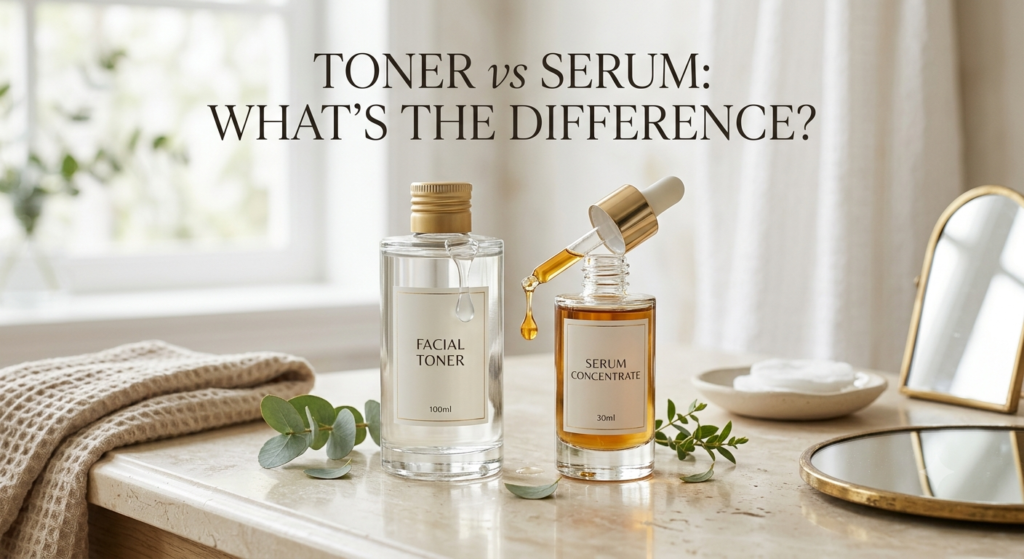
If you are building a skincare routine, you have probably seen toner and serum placed side by side—but they are not interchangeable. Toner is generally used after cleansing to refresh and prepare the skin, while serum is designed to deliver targeted ingredients for specific skincare concerns.
So, toner vs serum isn’t really about choosing a winner. The better choice depends on what your skin needs, the ingredients in the product, and how simple or targeted you want your routine to be.
In this guide, we’ll explain the difference between toner and serum, when to use each one, whether you need both, and how to layer them correctly.
What Is a Toner?
A toner is a lightweight skincare product typically applied after cleansing and before serum or moisturizer. Modern toners come in many different formulas, from simple hydrating products to formulas containing exfoliating or soothing ingredients.
Unlike traditional toners that were often associated with removing leftover residue, today’s toners can serve different purposes depending on their formulation.
What Does Toner Do?
A toner may help:
- Refresh the skin after cleansing
- Add lightweight hydration
- Prepare the skin for subsequent skincare products
- Provide soothing ingredients
- Help manage excess oil, depending on the formula
- Gently exfoliate when formulated with appropriate acids
The important point is that not every toner does the same thing. A hydrating toner and an exfoliating toner should not be treated as identical products.
Who Can Use a Toner?
Almost any skin type can potentially use a toner, but the formula matters more than the product category itself.
Dry skin: A hydrating toner can add a lightweight layer of moisture and help the skin feel more comfortable after cleansing.
Oily skin: A lightweight toner may feel comfortable on skin that becomes oily, particularly when the formula is designed to avoid a heavy finish.
Combination skin: A balanced, lightweight formula can work well when different areas of the face have different needs.
Sensitive skin: A simple, gentle formula is generally a better starting point than a toner containing multiple potentially irritating actives.
What Is a Serum?
A serum is a skincare product formulated around specific ingredients and skincare goals. Serums can have lightweight or slightly thicker textures, depending on their ingredients and formulation.
Unlike a basic refreshing step, a serum is usually selected because you want to focus on a particular concern such as dehydration, dull-looking skin, uneven skin tone, or the appearance of fine lines.
What Does Serum Do?
The benefit of a serum depends entirely on its formula.
For example:
Hyaluronic acid serums are commonly chosen for hydration.
Vitamin C serums are often used in routines focused on brightening and improving the appearance of uneven skin tone.
Niacinamide serums are commonly used for routines targeting oiliness, uneven-looking skin and the appearance of pores.
Retinoid-based products are often used for concerns related to skin texture and signs of ageing, although they require more careful use.
This is why choosing a serum based only on the word “serum” is not enough. The ingredients and their concentration, formulation and directions matter.
Toner vs Serum: Key Differences
| Feature | Toner | Serum |
|---|---|---|
| Main role | Refreshes and prepares the skin | Targets specific skincare concerns |
| Typical texture | Usually watery or lightweight | Lightweight to slightly viscous |
| When used | Usually after cleansing | Usually after toner and before moisturizer |
| Formula focus | Hydration, soothing, exfoliation or refreshing | Targeted active ingredients |
| Amount used | Usually applied over the face | Usually a small amount is sufficient |
| Best selected based on | Skin comfort and routine needs | Specific skin concern and ingredients |
| Do you need it? | Optional for many routines | Optional, depending on skincare goals |
The biggest difference is therefore purpose. Toner is usually a supporting step, while serum is more often chosen for a specific skincare goal.
Toner or Serum: Which Is Better?
There is no universal answer to toner or serum which is better.
If your priority is a simple routine and your cleanser already leaves your skin comfortable, you may not need a toner.
If you want to introduce a targeted ingredient for a particular concern, a serum may provide more value.
For example, someone dealing with dehydrated skin may prefer a hydrating serum, while someone who simply wants an additional refreshing step after cleansing may enjoy a hydrating toner.
The better product is the one that addresses your actual skincare need without unnecessarily complicating your routine.
Can You Use Toner and Serum Together?
Yes. Toner and serum can be used together because they generally serve different purposes.
A simple routine can look like this:
Cleanser → Toner → Serum → Moisturizer → Sunscreen
Toner is generally applied before serum because it is usually lighter in texture. After toner, serum can be applied according to the product’s instructions.
However, you do not need to add every available skincare step simply because it is popular. If using both makes your routine complicated or causes irritation, simplify it.
How to Use Toner and Serum Correctly
Step 1: Cleanse
Start with a gentle cleanser appropriate for your skin type. Cleansing removes daily buildup and prepares the skin for the rest of your routine.
Step 2: Apply Toner
Apply toner after cleansing. Depending on the product, you can gently pat it onto the skin with your hands or use a cotton pad.
Give the product a moment to settle rather than immediately layering several products.
Step 3: Apply Serum
Apply a small amount of serum and spread it gently across the face and neck if the product instructions allow it.
Do not assume that using a larger amount will produce faster results. Follow the recommended usage on the product.
Step 4: Moisturize
A moisturizer helps support the skin barrier and provides additional hydration depending on its formulation.
Step 5: Use Sunscreen in the Morning
For a daytime routine, finish with sunscreen. Sunscreen is especially important when your routine includes ingredients that can increase sensitivity to sunlight.
When Should You Use Toner?
Toner is generally used after cleansing.
A hydrating toner may fit into both morning and evening routines if your skin likes it. However, formulas containing exfoliating acids or other active ingredients may have different recommended frequencies.
Always follow the specific product instructions instead of assuming that every toner should be used twice a day.
Toner in the Morning
A hydrating or soothing toner can be a lightweight step before serum, moisturizer and sunscreen.
Toner at Night
At night, toner can be used after cleansing and before your serum or other treatment products.
If your toner contains exfoliating ingredients, avoid automatically combining it with several other strong actives.
When Should You Use Serum?
Serum can be used in the morning, evening, or both depending on its ingredients and the manufacturer’s instructions.
Morning Serum
Some antioxidant or hydrating serums can fit well into a morning routine. Follow them with moisturizer and sunscreen.
Night Serum
Some targeted treatments are better suited to an evening routine. Products containing retinoids, for example, require careful use and should be introduced according to product directions.
The important rule is simple: check the ingredients, usage instructions and compatibility with the rest of your routine.
Which Is Better for Different Skin Types?
Toner vs Serum for Dry Skin
Dry or dehydrated skin may benefit from a hydrating toner and/or a hydrating serum. Ingredients designed to attract or retain water can be useful, but moisturizer remains an important part of supporting skin hydration.
If you are choosing only one product, consider which step addresses your primary concern more directly.
Toner vs Serum for Oily Skin
For oily skin, a lightweight toner may provide a refreshing feel without a heavy layer. A serum can also be useful when chosen for a specific concern.
For example, someone concerned about excess oil may look for a suitable niacinamide-based formula rather than choosing a serum simply because it is marketed as a “glow serum.”
Toner vs Serum for Combination Skin
Combination skin can benefit from keeping the routine lightweight and targeted. A hydrating toner can provide comfort, while a serum can be selected around a specific concern such as dehydration or uneven-looking skin.
Toner vs Serum for Sensitive Skin
Sensitive skin usually benefits from a simpler approach. Look for gentle formulations and introduce new products one at a time.
Avoid assuming that “natural” or “active” automatically means gentle. The complete formulation matters.
Do You Need Both Toner and Serum?
No, you do not necessarily need both.
A basic skincare routine can be effective without toner:
Cleanser → Moisturizer → Sunscreen
A serum can then be added when you have a specific reason to use one.
Toner can be useful when you enjoy the additional hydration, soothing effect or other benefit offered by the particular formula.
The goal should not be to have the longest skincare routine. The goal is to have a routine that is appropriate, consistent and comfortable for your skin.
Toner vs Serum: Common Mistakes to Avoid
Using Too Many Active Ingredients
Layering several exfoliating acids, retinoids and other strong actives can increase the chance of irritation.
Introduce products gradually and understand what each formula contains.
Choosing Products Only Because They Are Trending
A viral toner or serum may not be the right product for your skin. Look at ingredients, formulation, product directions and your actual skincare goals.
Applying Too Much Serum
More product does not automatically mean better results. Use the amount recommended by the manufacturer.
Using Exfoliating Toner Too Frequently
An exfoliating toner is different from a simple hydrating toner. Follow its recommended frequency and pay attention to how your skin responds.
Skipping Sunscreen
A good skincare routine should not stop at serum. During the day, sunscreen is an important final step for protecting exposed skin from UV radiation.
Toner vs Serum: A Simple Decision Guide
If you’re still unsure what to choose, use this simple approach:
Choose a toner if:
You want a refreshing or hydrating step after cleansing, or you specifically like the benefits offered by the toner formula.
Choose a serum if:
You have a specific skincare goal and want to introduce ingredients selected for that concern.
Choose both if:
Your skin enjoys both products and they add useful benefits without making your routine unnecessarily complicated.
Choose neither if:
Your current routine already works well and adding another product does not solve a specific problem.
Final Verdict: Toner vs Serum
So, what’s the difference between toner and serum?
Toner is generally a lightweight step used after cleansing to refresh, hydrate, soothe or prepare the skin, depending on its formula. Serum is usually a more targeted skincare product selected around specific ingredients and concerns.
Neither is automatically better.
For a simple routine, you may not need toner. For a targeted skincare routine, a serum may be more useful. And if both products suit your skin, you can use them together in the order of toner first, serum second.
The smartest skincare routine is not necessarily the one with the most products. It is the one that matches your skin type, concerns, ingredients and lifestyle and that you can follow consistently.